Blog
“The energy transition is no longer a matter of idealism or political preference. Electrification isn’t just the sustainable choice: it’s the inevitable one. Simply because it’s economically, technologically and ecologically superior to fossil energy. That’s why at Greener we say: the energy transition would happen even if there were no environmental benefits.”

Just look at Texas, arguably the most conservative state in the US, where solar power has now become the largest source of energy. That hasn’t happened because Texans suddenly became more environmentally minded, but because solar energy has become cheaper than fossil fuels. Economics beats ideology.
The exponential growth of electrification
Solar energy has grown much faster in just a few years than anyone predicted. We’re now seeing the same happen with batteries. Humans have difficulty thinking exponentially, which makes it easy to underestimate how rapidly the energy market continues to evolve. Battery deployment is growing at an incredible pace, and that acceleration has only just begun.
Batteries were once criticised for their production impact. But new batteries are becoming increasingly efficient, sustainable and recyclable. While there used to be concerns about rapid degradation, modern batteries now easily last twenty years. Moreover, their production doesn’t rely on scarce materials like fossil fuels do. Sodium is partly replacing lithium, and while lithium itself isn’t scarce, its extraction is becoming increasingly cleaner and smarter.
Batteries also have virtually no moving parts, making them more reliable and low-maintenance compared to combustion engines. And with electricity now many times cheaper than diesel or petrol, battery systems are not only more sustainable, but also far more cost-effective.
Batteries are scaling rapidly because they’re backed by a proven business model. This rapid growth is crucial to the success of the energy transition, and with less and less legislation to deal with, it’s easier than ever to keep the growth going.
In a hypothetical level playing field, meaning no subsidies on either side, the combination of solar, wind and batteries clearly outperforms fossil energy.

Why batteries are indispensable
Solar and wind power aren’t constant: the sun doesn’t always shine and the wind doesn’t always blow. Batteries bridge those gaps, storing energy when there’s an abundance, and releasing it when there’s a shortage. In doing so, they make renewable energy reliable, scalable and profitable.
Our electricity grid is overloaded, partly due to excessive peaks in consumption. Batteries can absorb these peaks, making them essential to the energy transition.
Economically, technologically and ecologically the obvious choice
Producing fossil energy is a complex process involving countless steps: drilling, transporting, refining, storing and distributing. Each of these costs money and energy. Renewable energy, by contrast, is simple: wind and sun are directly converted into electricity and delivered to users via the existing grid. Batteries charge from the grid and supply additional energy directly to the load.
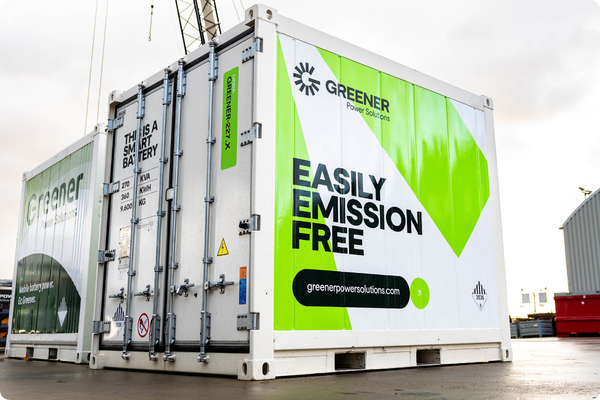
At Greener, we experience that simplicity every day. Our mobile batteries replace diesel generators at events, construction sites, charging hubs and temporary projects. It’s not only cleaner, it’s also cheaper, easier and more reliable.
A future that works
Electrification is no distant dream: it’s an economic reality. It’s the direction everything is naturally moving in: not because it has to, but because it simply works better.
At Greener, we’re building that future: where sustainability and profitability go hand in hand, and where smart energy storage quite literally keeps the world running.
That’s Greener’s vision: the energy transition would happen even if there were no environmental benefits.

