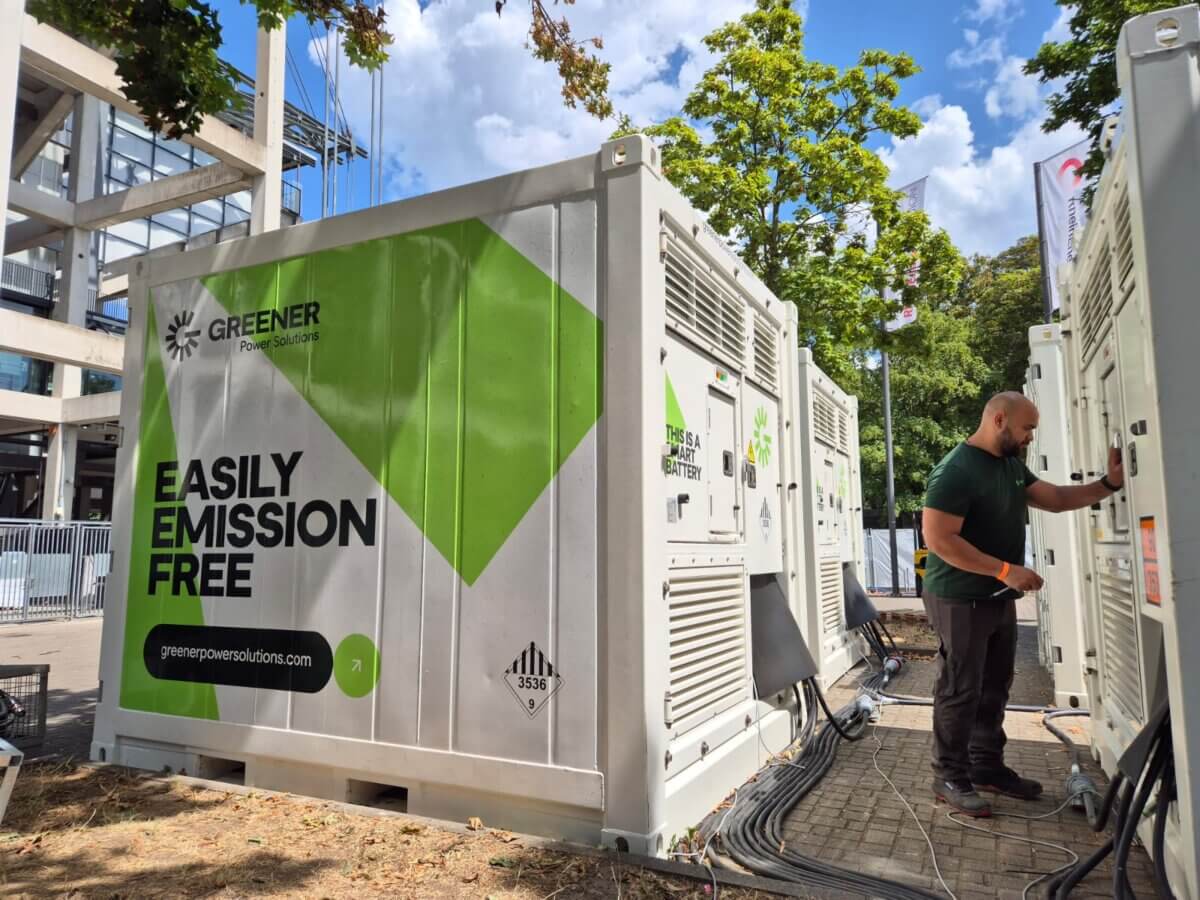
Battery 360 Mobile X
More specs
- Capacity
- 360 kWh
- Power
- 270 kVA
- Weight
- 9,600 kg
- Dimensions
- 10ft
- Input
- Powerlock 400A (125A CEE optional)
- Output
- 2x Powerlock 400A and 63A CEE
- Frequency
- 50/60Hz
- Voltage AC
- 400V
- Outside temperature
- -25°C to +35°C
- IP Rating
- IP54
MAIN RESULTS
• 2722 l fuel saved
• 87 generator running hours saved
• 9 tonnes of CO₂ saved
• 41 kg NOx saved
• Results above based on a 500kVA generator running always when there is energy measured at the load
• Batteries delivering dynamic loads with a high crest factor in a droop set-up combining batteries, grid and generators
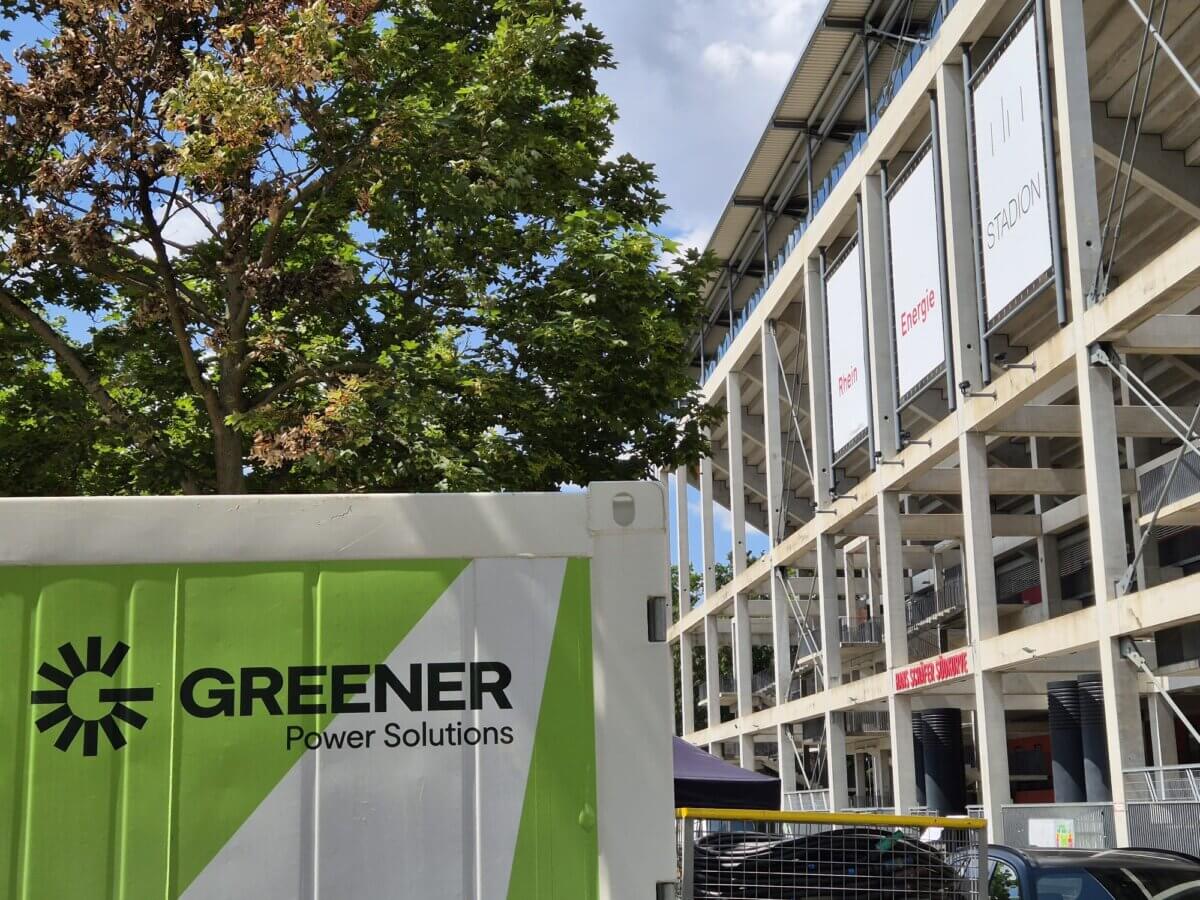
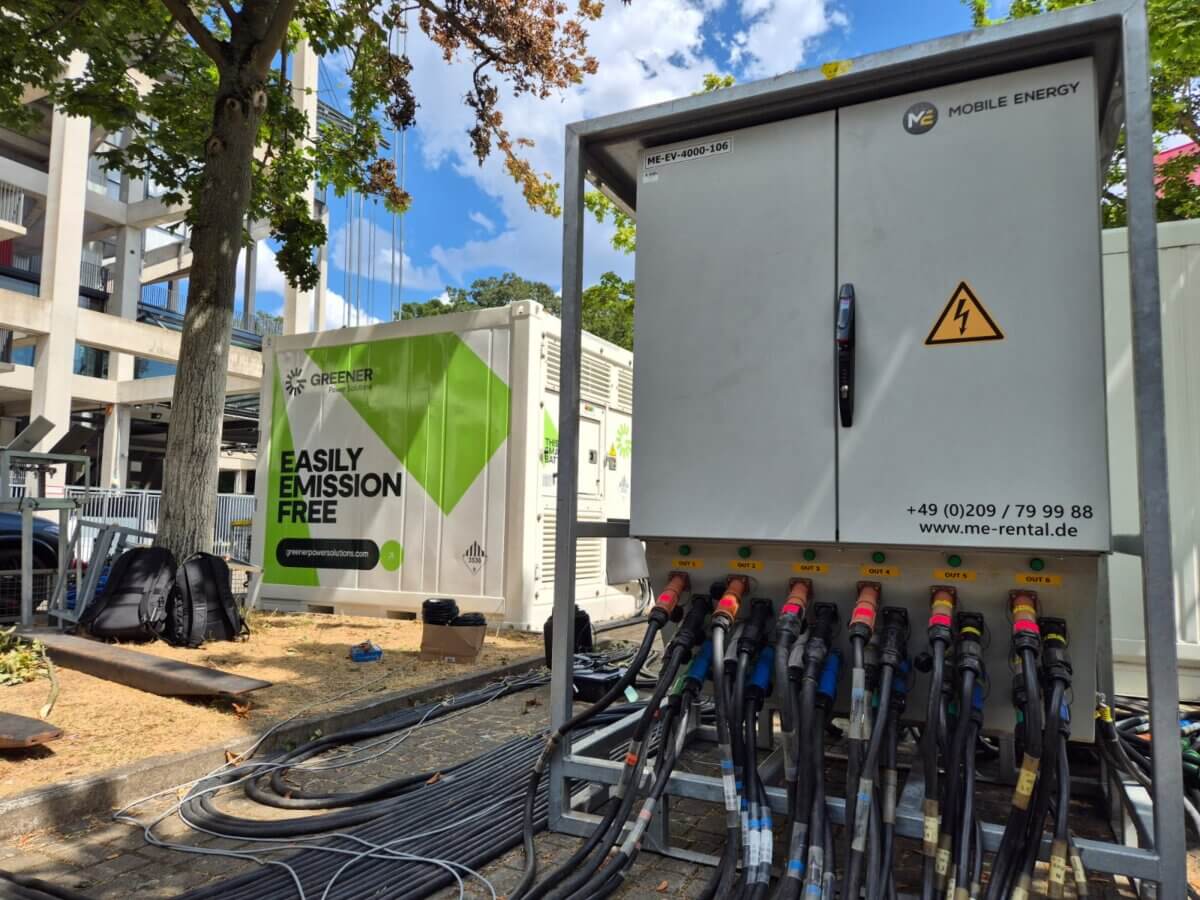
On behalf of Mobile Energy and prime entertainment, Greener powered the Die Toten Hosen shows at the RheinEnergieSTADION in Cologne, Germany, completely emission-free. The brief came directly from the band and tour promoter KKT GmbH. Sustainability was not optional. It was a requirement.
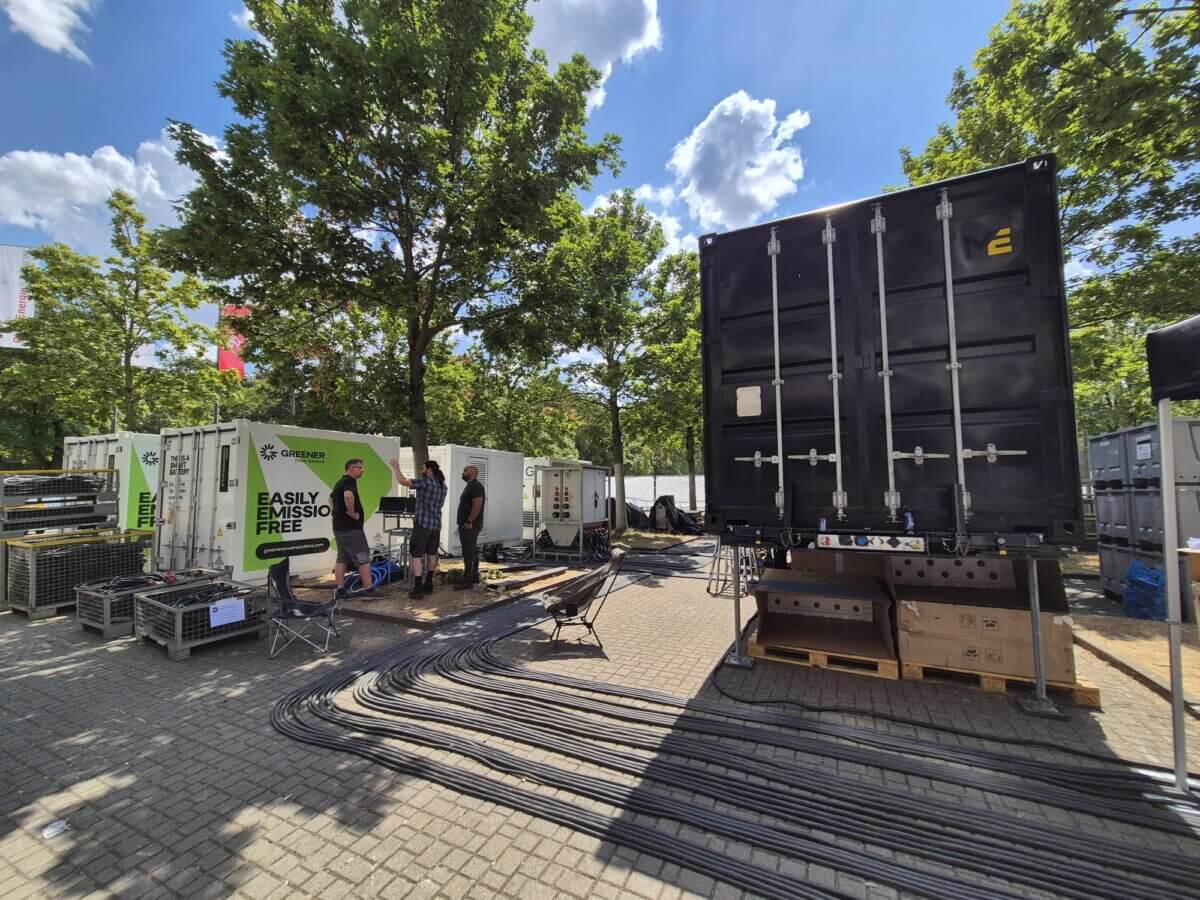
The setup: Six Greener battery systems (a combination of 318kVA and 270kVA) with a total storage capacity of 2900kWh forming a microgrid in a droop configuration, backed up by four 400kVA generators. The concert ran with a small grid connection (200A) on day one, and fully off-grid on day two. Apart from commissioning and testing, the generators were never turned on during the shows.
We powered the concert for 43,000 fans per day.
A punk band that has been swimming against the current for decades makes no exception when it comes to energy. What Massive Attack leads by example internationally, Die Toten Hosen are now showing on German stages: stadium concerts can be low-emission. Or, in this case, completely emission-free.
Here is how we did it.
FAST CHANGING LOADS WITH HIGH PEAKS
Concerts and shows have unique load patterns that batteries are optimally positioned to deliver. Everything turns on all at once, but not only that. A show’s energy matches the beat. High intensity in sound and lighting all at the same time. High. Low. High. Low. The loads are ramping up very quickly and have short peaks with a high crestfactor. Fast reaction times are particularly valuable for concert equipment such as sound, lighting, video and show-control systems, where sudden load steps occur within a very short time period.
During commissioning, the setup was stress-tested with a peak of 590kW. The highest peak we measured during the shows was 300kW, with an extremely fast ramp time. Although this was well below the setup’s maximum power capability, the additional power was essential to provide the required level of redundancy.
A battery has no rotating mass but is inverter-based, meaning that it can react much faster than a generator when load rises or drops. A generator reacts in seconds; a battery reacts in milliseconds. Making it perfect for dynamic loads.
USING DROOP FOR STABLE LOADS AND INCREASED REDUNDANCY
Using inverters, Greener battery systems can form a microgrid, meaning they create an independent energy system. Droop control via the Greener EMS allows multiple grid-forming systems to operate together in the same microgrid. Usually, in a multi-battery setup there is one central controller that defines how load is distributed to the batteries. In a droop setup, instead of relying on one central control point, all six batteries contribute power according to the configured droop settings. Information about the load is shared by all battery systems equally using the microgrids frequency and voltage. If a system fails, the load is redistributed automatically, without the need for manual intervention. Droop creates a self-balancing system that is highly resilient to fluctuations. It automates the failsafe of the assets that have been built into the setup to create enough energy in case something goes wrong.
When the load increases, the frequency of the microgrid created by the battery systems drops, causing them to discharge, and in doing so, levelling the frequency of the microgrid back to 50Hz. When power demand decreases, the microgrid frequency increases, and each battery inverter in turn decreases its power contribution to bring the frequency back to its nominal level of 50Hz. Because all six battery systems measure the same microgrid frequency, they respond together and share the load without requiring a central control signal for change in demand.
A droop setup creates a stable power supply even when the connected loads change rapidly. The battery inverters respond together, helping to maintain the microgrid’s frequency and voltage as demand rises and falls. Droop dramatically improves reliability and creates a self-operating failsafe system.
INCORPORATING A GRID CONNECTION INTO A DROOP CONTROLLED SETUP
One of the customer’s requirements was running the shows on as much clean energy as possible.
We achieved this by using the on-site national grid connection. The on-site grid connection was limited to 200A. To incorporate a national grid connection into a droop-controlled battery setup forming its own microgrid, the two grids have to remain separated. Greener Mobile X batteries come with two inverters: a unidirectional inverter with a rated current of 125A and a bidirectional inverter with a rated current of 400A. The Greener battery system separates the two grids (national grid and microgrid) using an AC–DC–AC conversion. Using a 125A unidirectional inverter, with a separate input, the AC grid power is converted to DC. On the DC side of the battery system, energy is either stored or used to power the load.The bidirectional grid-forming inverter converts the DC power back to AC and independently maintains the microgrid’s frequency and voltage.
The microgrid is able to use the national grid as an energy source while the systems stay completely separated.
The energy available from the 200A national grid connection was equally divided across four battery systems via their unidirectional inverters, reducing reliance on a single input path.If the national grid had been interrupted, the battery systems could have continued to supply the microgrid from stored energy. That’s exactly what happened on the second day. The concert ran entirely from stored energy as per request from the customer Mobile Energy.
“The Greener team understood what we were trying to do from day one. Six batteries, one system, zero diesel from the start. Getting the droop configuration right so all units shared the load evenly took real expertise on both sides. Running a stadium concert entirely off stored energy isn’t something you do alone. It’s what happens when two teams know their kit and trust each other.”
Patrick Fischer – Mobile Energy